EROS
ἔρως
The word this walk is made of.
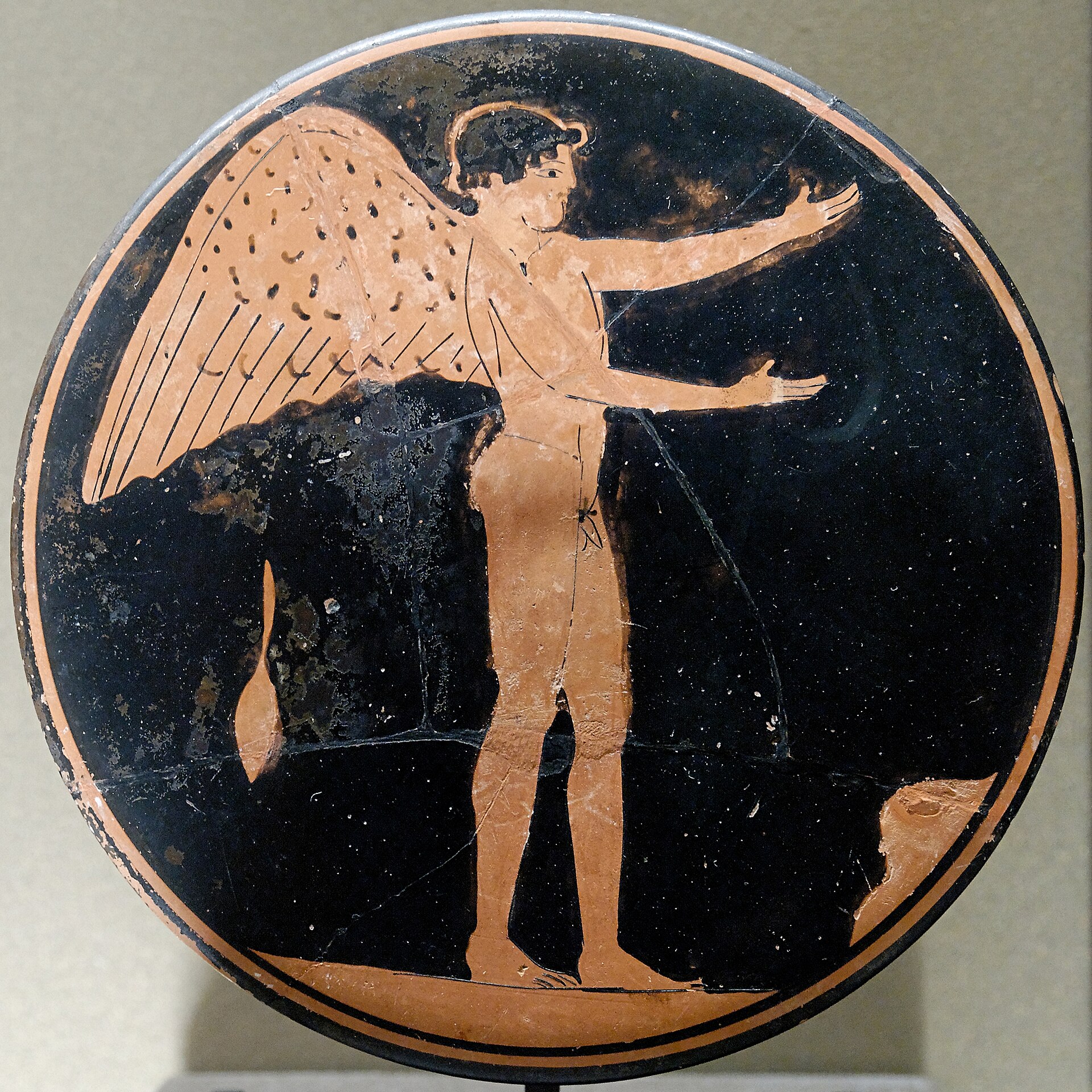
In early poetry it can name a cosmogonic force, a god, and the experience of being undone by desire. Later it becomes one figure among the Erotes, and then Cupid.
V
Greek culture distinguished kinds of wanting. The figures remain fluid. English labels are a way in.
EROS
ἔρως
The word this walk is made of.
In early poetry it can name a cosmogonic force, a god, and the experience of being undone by desire. Later it becomes one figure among the Erotes, and then Cupid.
HIMEROS
ἵμερος
Attested with Aphrodite in Hesiod, Theogony 201.
Often rendered longing. In Hesiod, beautiful Himeros follows Aphrodite at her birth, with Eros. Pausanias later names a Skopas statue of Himeros beside Eros and Pothos at Megara.
POTHOS
πόθος
Yearning toward what is absent.
Later sources and art treat Pothos as a personified yearning, frequently for what is distant or gone. Skopas grouped Pothos with Eros and Himeros.
ANTEROS
ἀντέρως
Answering love, local cult.
Pausanias records an Athenian altar of Anteros tied to the deaths of Timagoras and Meles, and images of Eros and Anteros in a palaestra at Elis. Reciprocal love, answering love, and love avenged are later English attempts at the office.
Pausanias, writing in the second century CE, could still point to statues of Eros, Himeros and Pothos together at Megara, and to an altar of Anteros in Athens.
The body of Eros will arrive later, through objects. First the force. Then the names. Then the image that history kept changing.
Eve
Desire had a vocabulary
0:000:00